


Tax season can feel overwhelming, especially if you are an international student getting to grips with the U.S. tax system for the first time!
One form that often causes confusion is the Form 1098-T.
You may have received one from your university and are wondering what it is, whether you need it, and how it affects your taxes.
This guide explains everything nonresidents in the U.S. need to know about Form 1098-T!
Key takeaways
- The 1098-T is a tuition statement issued by U.S. colleges showing tuition paid and scholarships received.
- Most international students on F-1 and J-1 visas are classified as non-resident aliens and usually cannot claim education tax credits.
- Even if you receive a 1098-T, it typically does not reduce your tax bill or increase your refund as a non-resident.
- The form itself is not taxable, but scholarship amounts that exceed tuition may be taxable income.
- Many international students will also receive a 1042-S, which is often more important for tax filing than the 1098-T.
- You do not need the 1098-T to file with Sprintax, but you should keep it for your records.
- Your tax residency status determines whether the 1098-T is relevant for credits or only informational purposes.
What is the 1098-T form?
The 1098-T is a tuition statement issued by eligible U.S. colleges and universities to students who paid qualified tuition and related expenses during the tax year.
It is filed with the IRS by your educational institution.
In simple terms, the form shows how much you paid in tuition and fees, and whether you received any scholarships or grants.
This information is used by eligible taxpayers to claim education tax credits, such as the American Opportunity Tax Credit or the Lifetime Learning Credit.
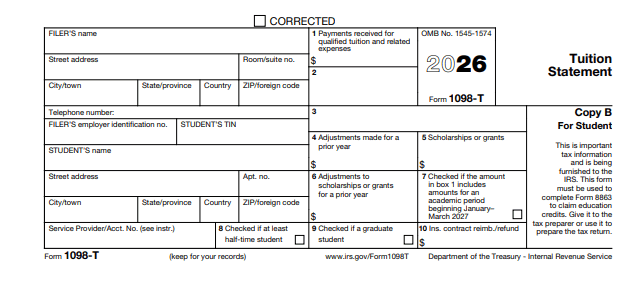
Box 1 reports the amount paid for qualified tuition, while Box 5 shows any scholarships or grants received. If your scholarships exceed your tuition, the difference may be considered taxable income.
| Box number | Box title | What it means for you |
|---|---|---|
| Box 1 | Payments received | Total "qualified" tuition and fees paid. Note: This doesn't include room and board! |
| Box 5 | Scholarships or grants | Money you didn't have to pay back. If this is higher than Box 1, you might owe tax. |
Do international students receive a 1098-T?
Many international students do receive a 1098-T, but this depends on the institution.
Some universities issue the form automatically to all students, while others only provide it upon request.
Your university will usually send the form by 31 January, either by mail or electronically through your student portal. If you have not received one and think you should have, contact your school’s bursar or financial services office.
You may also be able to download it from your student account.

Can international students use the 1098-T?
Most international students on F-1 or J-1 visas are classified as nonresident aliens for U.S. tax purposes during their first few years in the U.S.
The education tax credits linked to the 1098-T are generally not available to nonresident aliens.
This means that even if you receive the form, you likely cannot use it to claim a tax credit or deduction on your federal tax return. The 1098-T is mainly relevant for U.S. residents and citizens.
However, there is an important exception. If your scholarship or grant exceeds your qualified tuition and fees, the excess amount may be taxable. In that case, the form is still relevant to your tax situation.
Can international students claim education credits?
Nonresident aliens are generally not eligible to claim education tax credits. However, your eligibility depends on your tax residency status.
Some international students who have been in the U.S. longer may qualify as resident aliens under the substantial presence test. If this applies, they may be eligible to claim education credits.
F-1 and J-1 visa students are usually considered exempt from the substantial presence test for their first five calendar years, meaning they remain nonresident aliens. Other category J-1 visa holders are typically exempt for their first two calendar years.
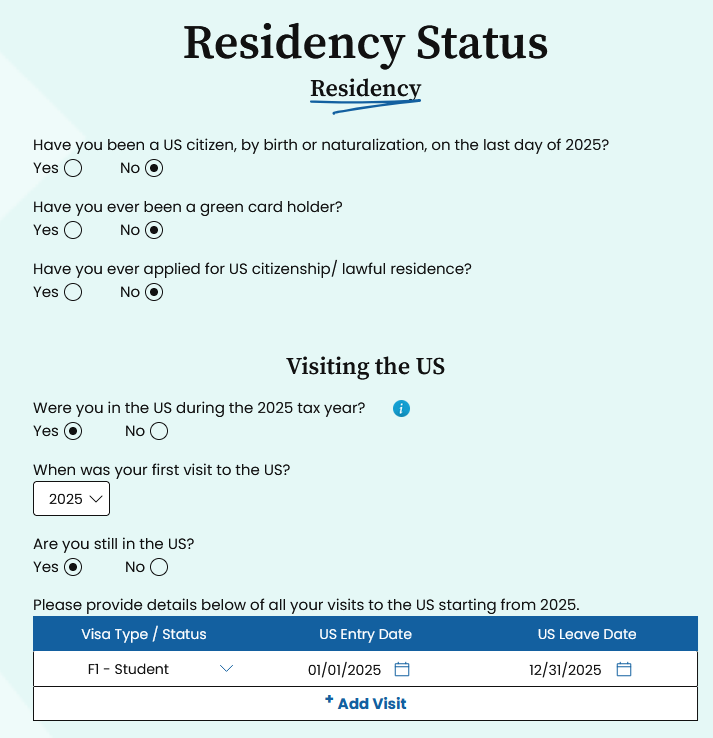
If you are unsure about your residency status, it is important to determine this before filing your taxes.
The residency test is the first step in Sprintax Returns.
How to get my 1098-T form online as a nonresident
If you are looking to find your 1098-T, there are a few different routes for you to take.
University
You can reach out to your university’s Bursar/Student Accounts/Tax Office and ask if they can issue a 1098-T upon request.
Once you provide a valid SSN or ITIN and have specifically requested the form, they should provide you with it.
Portal
Alternatively, you can check your student portal. Many universities provide 1098-T forms electronically through platforms like:
Log into your school account and look for: “Tax Documents”.
Then, search “1098-T”. The form should appear in your documents.

Does the 1098-T affect your tax refund?
For U.S. residents and citizens, the 1098-T can increase a tax refund if it allows them to claim education credits.
For most international students who are nonresident aliens, the form does not increase your refund because you are not eligible for those credits.
What is the difference between 1098-T and 1098-E?
The 1098-T is a tuition statement, while the 1098-E is a student loan interest statement.
The 1098-E reports how much interest you paid on student loans during the year. U.S. residents may be able to deduct this interest, but this deduction is generally not available to nonresident aliens.
| Feature | Form 1098-T | Form 1098-E |
|---|---|---|
| Official name | Tuition Statement | Student Loan Interest Statement |
| Purpose | Reports tuition and related expenses paid for higher education. | Reports the amount of interest paid on student loans during the year. |
| Tax benefit | Used to claim education credits (like the AOTC or LLC). | Used to claim the student loan interest deduction. |
| Eligibility | Typically for students enrolled at an eligible institution. | Generally not available to nonresident aliens. |
Do you need to file the 1098-T?
If you are a nonresident alien and not eligible for education credits, you do not need to file the 1098-T with the IRS along with your tax return. However, you should keep it for your records.
What happens if I don’t file my 1098-T?
If the form shows taxable scholarship income and you fail to report it, you may face penalties.
There is no penalty for not filing the form itself, but failing to report taxable income is an issue.
1042-S vs 1098-T: which form matters more?
For international students, the 1042-S is usually more important than the 1098-T.
The 1042-S reports income subject to U.S. tax withholding, including taxable scholarships, fellowship payments, and income covered by tax treaties. It is typically issued by March 15.
While the 1098-T may still be provided, the 1042-S is the key document used when filing taxes as a nonresident.

Do you need the 1098-T for Sprintax?
You do not need the 1098-T to use Sprintax.
Sprintax is designed specifically for nonresident aliens and international students and guides you through the process using the documents relevant to your situation.
To get started, you will need:
- Your passport
- U.S. entry and exit dates
- Income documents such as W-2 and 1042-S forms
- Visa information
- Your SSN or ITIN.
If you are filing a state tax return only, you will also need a copy of your completed federal return.
Filing taxes as an international student is different from filing as a U.S. resident. There are different forms, rules, and eligibility criteria.
The 1098-T is a good example. It may seem important, but for most international students on F-1 or J-1 visas, it does not affect your tax return in the way many expect.
What matters most is understanding your tax residency status, using the correct forms, reporting any taxable scholarship income, and filing the appropriate return.
Ready to file your U.S. tax return as a nonresident?
Sprintax Returns makes it simple.
Get started today and ensure your taxes are filed accurately, with any eligible treaty benefits applied.