


Are you an OPT/CPT program participant?
While doing your taxes might not be the most exciting aspect of international student life in the US, the importance of filing your federal tax return correctly cannot be underestimated.
With this in mind, we’ve created this handy tax guide for international students on OPT.
What is OPT?
Optional Practical Training (OPT) is an opportunity for international students under an F-1 visa to work in the US for 12 months. After this, STEM students (Science, Technology, Engineering and Mathematics) can extend this period up to 24 months.
Most students complete OPT after graduating from university. Others participate after they have been pursuing their degree for more than nine months and are entitled to work and gain practical knowledge in the field of their studies.
Types of OPT
There are three main types of OPT, depending on where you are in your academic journey.
1. Pre-Completion OPT
Pre-Completion OPT is authorized before you graduate, typically when Curricular Practical Training (CPT) is not available or does not fit your program requirements.
Students may work:
- Part-time (up to 20 hours per week) while school is in session
- Full-time during official school breaks, such as summer vacation
Any employment must be directly related to your major field of study. Time used for pre-completion OPT is deducted from your total 12 months of OPT eligibility.
From a tax perspective, students on pre-completion OPT are usually still considered nonresidents for U.S. tax purposes, depending on how long they’ve been in the U.S.
2. Post-Completion OPT
Post-Completion OPT is the most common form of OPT and is authorized after graduation.
It allows eligible F-1 students to work:
- Full-time
- For up to 12 months
- In a role directly related to their degree program
Many international students use post-completion OPT to gain professional experience, build U.S. work history, or transition to longer-term employment options.
During post-completion OPT, students may remain nonresidents or become residents for tax purposes, depending on whether they meet the Substantial Presence Test. Remember, this can affect how income is taxed and which tax forms must be filed.
3. STEM OPT Extension
Students who graduate with a qualifying STEM (Science, Technology, Engineering, or Mathematics) degree may be eligible for a 24-month STEM OPT extension, allowing for up to 36 months of OPT total.
The STEM OPT extension provides additional time to gain specialized work experience and is often used by students pursuing longer-term work authorization options in the U.S.
Do OPT students pay taxes?
One of the most common questions we receive is: “Do I have to pay taxes on OPT?”
In short, yes, if you earn income while in the U.S. for OPT, you are required to pay your Federal and State income taxes.
You must also complete a W-4 tax form with your new employer when you start a new job.
The U.S. tax deadline in 2026 falls on 15 April.
It’s vitally important that you file your taxes in time for the deadline. By not filing you risk having issues with future Green Card and visa applications as well as fines and penalties.
Sprintax Forms tax software can help prepare a W-4 for international students on OPT.
Are you an F-1 visa student on OPT working as a self-employed or a freelancer? Read our tax guide here.

Residency status of OPT students
It’s crucial to determine your residency status for tax purposes, as it affects how your income is taxed and which tax forms you must file.
In most cases, international students in F-1 status are considered nonresident aliens for tax purposes during their first five calendar years in the United States. This is because those years are typically exempt from counting toward the Substantial Presence Test (SPT).
If you have been in the U.S. for more than five calendar years, you will usually be considered a resident alien for tax purposes, provided you meet the Substantial Presence Test.
What is the Substantial Presence Test (SPT)?
The Substantial Presence Test is an IRS calculation used to determine whether a non-U.S. citizen should be treated as a resident or nonresident for tax purposes. It looks at:
- The number of days you were physically present in the U.S. during the current year
- Plus a weighted portion of days from the previous two years
Once your exempt F-1 student years end, your U.S. days of presence begin counting toward this test — which means many OPT students may transition from nonresident to resident tax status while working in the U.S.
Because this calculation can be complex, especially for students who have changed visa types or traveled frequently, it’s important to check your status each tax year.
You can determine your residency status for FREE with Sprintax Returns by taking the Substantial Presence Test.
Tax rates for OPT students
The IRS requires federal income tax withholding on all U.S.-source payments to nonresident alien students.
2025 Federal tax rates
OPT students are taxed on their wages at graduated rates from 10% to 37% (it depends on your income level). The tax percentage withheld on scholarships and grants for F-1 and J-1 visa holders is 14%.
| Income | Tax rate |
|---|---|
| $0 to $11,925 | 10% |
| $11,926 to $48,475 | 12% |
| $48,476 to $103,350 | 22% |
| $103,351 to $197,300 | 24% |
| $197,301 to $250,525 | 32% |
| $250,526 to $626,350 | 35% |
| $626,351 or more | 37% |
State Tax
You may also have to pay state tax on your income depending on where you live in the U.S. and your personal circumstances.
Each state has different rules involving its tax laws. In fact, there are nine states that don’t charge tax on income:
- Alaska
- Florida
- Nevada
- New Hampshire (taxes only investment income, not earned income)
- South Dakota
- Tennessee
- Texas
- Washington
- Wyoming
If you live or work in a state that does charge income tax, you may be required to file a state tax return in addition to your federal return.
Your state tax obligations depend on several factors, including where you lived, where you worked, and how long you spent in each state during the tax year. Some individuals may need to file more than one state return if they moved or worked in multiple states.
State tax rules are separate from federal tax rules, and filing a federal return does not automatically satisfy state filing requirements. Reviewing your state situation carefully can help avoid missed filings or unexpected tax notices later.
Find out more on state taxes at our guide here.
OPT student tax exemptions
FICA tax exemption
As an F-1 visa holder, you are exempt from FICA (Social Security and Medicare) taxes for the first 5 years.
This means that no matter whether you are doing OPT, OPT extension or CPT (Curricular Practical Training), you are exempt from paying Social Security and Medicare taxes unless you’ve been in the United States for more than 5 years.
Read more about the student FICA tax exemption and how to claim a FICA tax refund here.
Tax deductions
As a nonresident, you may be eligible for OPT tax deductions.
While there is no specific OPT tax relief, you may be able to claim the following credits should you qualify for them:
- Child tax credit
- Child and dependent care tax credit
- Foreign tax credit
- Retirement savings contribution credit
- Credit for other dependents
- Adoption credit
How to file a tax return while on OPT in the U.S.?
If you are working in the U.S. on OPT, you are required to file a U.S. tax return.
Forms you may need to file
Most OPT students will need to file the following forms:
Form 8843
This form is required for all F-1 students, even if you had no income. It is used to confirm your visa status and your days of presence in the U.S.
Form 1040-NR
This is the U.S. federal income tax return for nonresidents. Form 1040-NR reports your income, taxes withheld, and any refund due.
Documents you need to file your taxes
To complete your tax return, you will usually need:
- Social Security Number (SSN) or ITIN
- Form W-2 from your employer
- Form 1042-S (if applicable)
- OPT EAD card
- U.S. address history
- Details of any tax treaty benefits
Tax filing deadline
The standard federal tax filing deadline is 15 April each year.
If you only had income subject to withholding and no wages, the deadline may be June 15 (if you live outside the U.S.).
Deadlines can change slightly each year, so it is important to confirm the correct filing date.
Filing your tax return with Sprintax Returns
Sprintax Returns is the only self-preparation tax software designed specifically for nonresidents in the U.S.
After answering a series of guided questions, Sprintax will:
- determine your tax residency status
- Prepare the correct tax forms you must file
- apply any eligible tax treaty benefits
- prepare your completed federal tax return
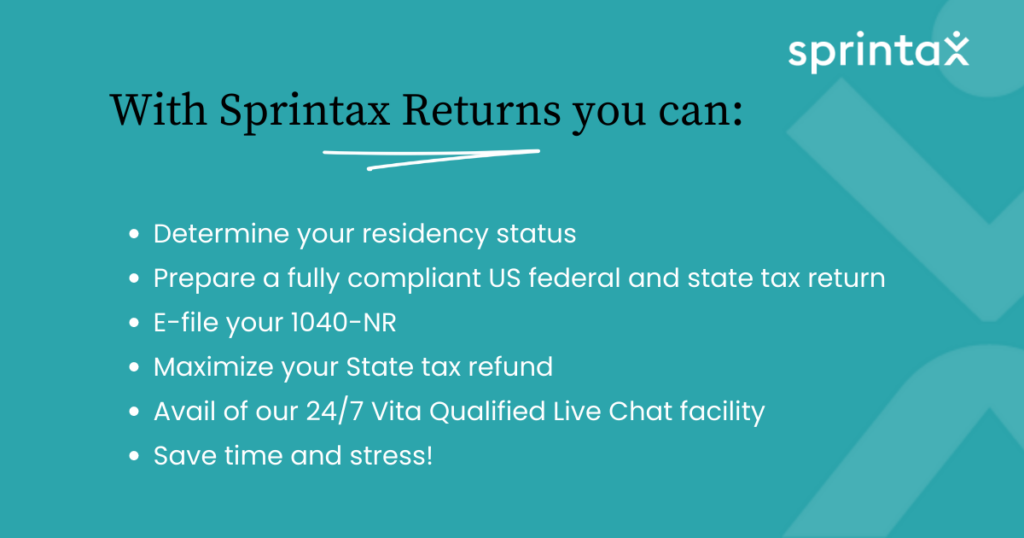
With Sprintax Returns software you can:
- Save time and stress!
- Determine your residency status
- Prepare a fully compliant U.S. federal and state tax return
- E-file your 1040-NR
- Maximize your State tax refund
Prepare your OPT student tax return here
Can I claim a tax treaty benefit?
The U.S. has tax treaties with many countries that may reduce or eliminate federal tax on certain types of income.
If you qualify, tax treaty benefits may allow you to:
- reduce the amount of tax withheld from your paycheck
- exclude some income from U.S. taxation
Common forms used for tax treaty benefits
Form W-8BEN
This is used only for FDAP (Fixed, Determinable, Annual or Periodical income).
Form 8233
Used to claim treaty benefits specifically on compensation for services, such as wages.
Important: These forms are provided to your employer/payer at the time of hiring so they don’t take tax out of your paycheck.
Tax treaty eligibility depends on:
- your country of tax residence
- your visa type
- the treaty article
- time limits specified in the treaty
Not all students qualify, and treaty benefits often expire after a certain number of years.
Missed the paperwork earlier?
Even if you didn’t provide Form 8233 or W-8BEN to your employer and they withheld the full tax from your pay, you can still claim the treaty benefit when you file your tax return.
Sprintax Returns reviews your personal situation and automatically determines whether a tax treaty benefit applies and which form should be used. Sprintax will include the necessary forms (like Form 8833) to help you get that overpaid tax back as a refund.
OPT to the H1B tax filing
H-1B status is not exempt from the Substantial Presence test and very often H1B visa holders become residents or dual-status residents in the year of visa change.
Depending on their personal circumstances, F-1 students on OPT may claim a tax treaty that can partially reduce or fully exempt their income from paying taxes.
However, H1B visa holders must pay FICA tax and are usually not entitled to use tax treaty benefits for students and scholars. Check out this detailed guide on filing taxes on an H1B visa.
Remember, if you have questions about your personal tax situation, our Live Chat team is online 24/7 to support you.
Do OPT students get a tax refund?
Yes.
Every year, thousands of OPT participants overpay taxes in the USA and are entitled to a tax refund when they file their tax returns.
Sprintax will help you with the preparation of your tax documents and will make sure you claim the maximum legal tax refund.
The average federal tax refund a Sprintax Returns customer receives is $927!
Prepare your OPT student tax return with Sprintax easily online.
Key tips for OPT students starting a new job
Starting a new job on OPT comes with important tax responsibilities. Taking the correct steps early can help avoid problems later.
1. Confirm your tax residency status
Your residency status determines which tax forms you must complete and which tax benefits you may claim.
Most students remain nonresidents for tax purposes during their first five calendar years in the U.S., but this can change depending on time spent in the country.
2. Complete the correct forms for your employer
When you start a new job, your employer will ask you to complete tax forms for payroll.
Common forms include:
- Form W-4 to set your federal tax withholding
- State withholding forms, if applicable
You will usually need to provide:
- Social Security Number (SSN)
- Passport and visa details
- OPT EAD card
Filling these forms correctly helps ensure the right amount of tax is withheld from your paycheck.
3. Understand your pay documents
You should receive:
- Pay stubs showing taxes withheld
- Form W-2 at the end of the year
Keep these documents, as they are required to file your tax return.
4. File any missing tax returns
If you missed filing a tax return for a previous year, it is strongly recommended to file it as soon as possible.
Filing late helps you:
- remain tax compliant
- avoid future immigration or visa issues
- claim any refund you are still entitled to receive

Form W-9 vs Form W-8BEN for OPT students
Many OPT students are unsure whether they should complete Form W-9 or Form W-8BEN.
The correct form depends on your tax residency status, not your visa type.
When do OPT students use Form W-8BEN?
Most OPT students are nonresidents for tax purposes.
In this case, you should complete Form W-8BEN, not Form W-9.
Form W-8BEN tells your payer that:
- you are not a U.S. tax resident
- you are subject to nonresident tax rules
- tax treaty benefits may apply
This form is commonly requested if you are paid outside standard payroll or receive certain types of income.
When is Form W-9 used?
Form W-9 is used for FDAP income only by:
- S. citizens
- Green card holders
- Individuals who pass the Substantial Presence Test
If you become a resident for tax purposes while on OPT, you may be required to submit Form W-9 instead of Form W-8BEN.
Can OPT students work as independent contractors on a W-9?
In most cases, OPT students should not work as independent contractors.
Freelance or contract work paid using a W-9 is usually only allowed for U.S. tax residents. Accepting this type of work incorrectly can lead to tax and immigration issues.
Always confirm both immigration and tax eligibility before accepting contract work.






![IRS form 8843 instructions [2026]](https://blog.sprintax.com/wp-content/uploads/How-to-file-form-8843-Instructions-380x220.jpg)